The $10,000 roof grant — how it actually works
The SAH process has real steps, real timelines, and real gotchas. Here's everything you need to know before you apply.
Funding rounds open quarterly — and recent rounds have been claimed in under an hour. Applications do not roll over automatically, so the homeowners who get funded are the ones whose paperwork is already gathered. Have us check your paperwork before the next window opens, at no charge, whether or not you end up using us.
Before you apply, understand the structure
The Strengthen Alabama Homes (SAH) program is funded by the Alabama Department of Insurance and provides grants of up to $10,000 for homeowners to upgrade to the IBHS FORTIFIED Roof standard. It's a legitimate, well-funded program — but it works differently from hiring a contractor directly.
The process is homeowner-driven: you apply, you choose your evaluator, and you choose your contractor from an approved list. Bowab is on that list. Homeowners who understand the full process upfront have a much smoother experience — and fewer surprises at the end.
The SAH grant is available quarterly to any Alabama homeowner with a primary residence and a homeowners policy with wind coverage. There are no income limits.
The 7 steps, explained
Here's what actually happens from application to finished roof.
Create your SAH profile & submit the application
Go to strengthenalabamahomes.com, create a profile, and submit your application. You'll then have 7 days to upload income verification, your insurance declaration page, and the vendor disclosure form. Act fast — grants are first-come, first-served and can be gone in minutes, so have every document ready before the window opens (the insurance dec page is the one most people scramble for). If you need help, Bowab can connect you with local nonprofits.
Choose a FORTIFIED evaluator
After your documents are reviewed, you'll be notified to select a certified FORTIFIED Evaluator — an independent third party, not a contractor — who inspects your home and documents exactly what work is needed to reach the FORTIFIED Roof standard.
Get three bids from SAH-approved contractors
Once the evaluation is complete, you choose three contractors from the approved list to bid on the evaluator's scope of work. All three bids go to SAH before any work begins.
Receive your grant award letter
After all three bids are in, SAH issues your grant award letter confirming the amount (up to $10,000). Do not let any contractor start before you have this letter — it's your protection.
Work is completed to FORTIFIED standards
Your contractor completes the mitigation work. FORTIFIED is specific — sealed roof deck, ring-shank nails, proper flashing and more. The evaluator documents compliance alongside the contractor.
Receive your IBHS FORTIFIED designation certificate
Once the work passes inspection you receive the official FORTIFIED certificate from IBHS. Keep it — it's your proof. SAH then pays your contractor up to the grant amount.
Get your insurance discount applied
Take the certificate to your insurance agent and request the mitigation discount. Alabama law requires admitted carriers to honor it; surplus carriers are not obligated, so if yours is a surplus carrier, consider shopping the policy. Upload the new declaration page with the discount to finalize your SAH application.
What to realistically expect
- Day 1–7Application submitted and required documents uploaded within the 7-day window.
- Week 2–3Documents reviewed by SAH. You're notified to select a FORTIFIED Evaluator.
- Week 3–5Evaluator inspection completed. Scope of work documented and submitted.
- Week 5–7Three contractor bids gathered and submitted. Grant award letter issued.
- Week 7–9Roof installed, evaluated, and submitted for FORTIFIED certification.
- Week 9–12Certificate received. Grant paid to the contractor. Insurance discount applied.
What homeowners actually pay above the grant
Most guides to this program stop at “up to $10,000.” The question every homeowner actually asks us is the next one: what do I pay?
We have been an SAH-approved contractor since the program’s early days in 2022 and have completed hundreds of FORTIFIED roofs through it. Here is the honest answer.
On a typical single-story Gulf Coast home, plan on roughly $3,500 to $5,000 of your own money on top of the grant. Smaller, simpler roofs sometimes land at the grant amount with nothing out of pocket. Steep, cut-up or two-story roofs run higher, and on a large home the grant may cover only part of the job.
Anyone who quotes you a flat number before the evaluator has scoped your roof is guessing. The evaluator’s report drives the work, and the work drives the price.
We will walk your roof and tell you where you are likely to land before you commit to anything.
Where we have done grant roofs
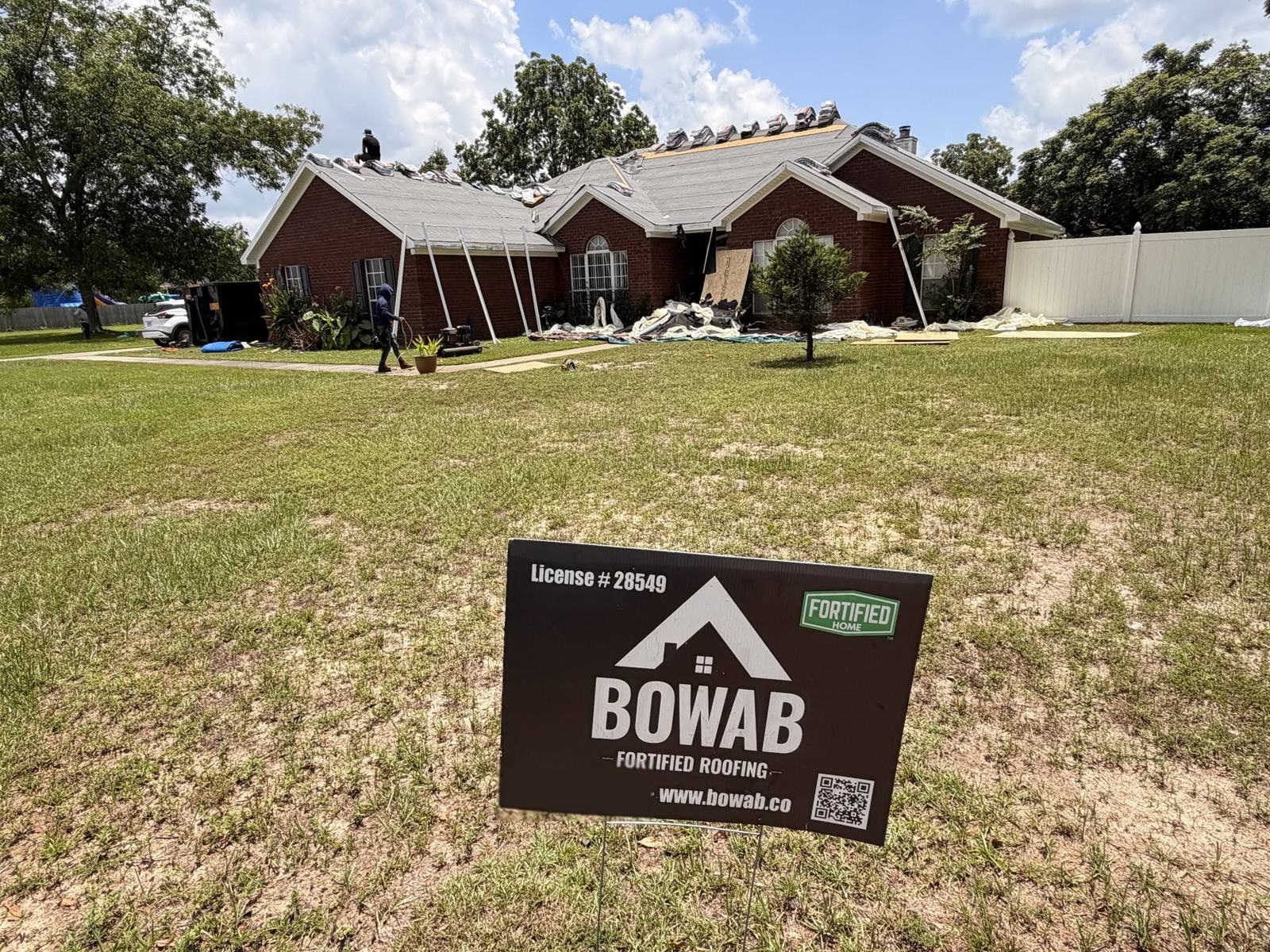
We are an SAH-approved contractor based in Lillian, and grant roofs are the core of what we do. Across Mobile and Baldwin County that includes Mobile, Daphne, Fairhope, Foley, Gulf Shores, Spanish Fort, Lillian, Elberta, Silverhill, Stapleton, Bay Minette, Grand Bay and Eight Mile. We have also completed SAH roofs well outside the coast, in Brewton, Atmore, Monroeville, Enterprise, Dothan, Selma, Montgomery, Tuscaloosa and Northport.
That matters for one practical reason: the program requires three bids from approved contractors, and plenty of homeowners in outlying areas struggle to find three who will actually drive out. If you are having trouble filling your bid list, call us and we will tell you straight whether we can get to you.
Frequently asked questions
Is there an income limit to qualify?
No. The SAH program is open to all Alabama homeowners regardless of income, as long as the home is your primary residence, owner-occupied, and a single-family home with a homeowners insurance policy that includes wind coverage.
What if my roof costs more than $10,000?
The grant covers up to $10,000 of the total cost. Anything above that is the homeowner's responsibility, paid directly to the contractor under your contract. It's important to understand this before work begins — the SAH process cannot be paused mid-project to sort out overages. Discuss the full cost and any potential gap with your contractor before signing.
Can I pick any contractor I want?
You must choose from the SAH-approved contractor list, and you must get three bids. However, you are free to choose any of those three contractors — it doesn't have to be the lowest bid. You can weigh communication, materials, experience, and any other factor that matters to you.
When does the grant funding open each year?
The Alabama Department of Insurance provides funding quarterly. Grant availability can vary — if a funding round closes before your application is processed, your application rolls into the next cycle. Getting your application in early in a funding quarter gives you the best chance of same-cycle approval. The current schedule is posted at strengthenalabamahomes.com.
What insurance discount can I expect?
Discounts vary by insurer, but homeowners with a FORTIFIED Roof designation can typically see discounts on the wind portion of their homeowners premium. Some insurers offer up to 30% on the wind portion for five years. Alabama law requires admitted carriers to apply the discount — surplus carriers are not required to. If your current insurer is a surplus carrier, the FORTIFIED certificate is a strong reason to shop your policy.
What does the evaluator do, and do I need to be present?
The FORTIFIED Evaluator is an independent certified inspector who assesses your home's current condition and documents exactly what work is needed to reach the FORTIFIED Roof standard. They also monitor the installation and submit documentation for certification. It's helpful to be present for the initial inspection, but not required. Ask your evaluator what they prefer.
Does a FORTIFIED roof help if I sell my home?
Yes. A University of Alabama study found that FORTIFIED homes sell for nearly 7% more than comparable non-FORTIFIED homes. In addition to the resale value, transferability of the insurance discount can be a selling point for buyers, depending on the carrier.
Can I get a grant from Alabama for a new roof?
Yes. Strengthen Alabama Homes, funded by the Alabama Department of Insurance, awards up to $10,000 toward a roof rebuilt to the IBHS FORTIFIED standard. It is open to any Alabama homeowner with a primary residence and a homeowners policy that includes wind coverage, with no income limits. It is not a repair program — the grant is for a full roof replacement built to the FORTIFIED specification, and the work has to be done by an approved contractor and inspected by a certified evaluator.
Is Strengthen Alabama Homes legit?
It is. The program is run by the Alabama Department of Insurance, not a private company, and the grant is paid to the contractor after the work passes FORTIFIED inspection — nobody asks you for the grant money up front. The confusion usually comes from contractors marketing it as a “free roof.” For most homeowners it is not free: the grant caps at $10,000 and a full FORTIFIED replacement typically costs more than that. If someone promises the grant will cover everything before an evaluator has scoped your roof, be careful.
How much does it cost to fortify an existing roof?
Building to the FORTIFIED standard — ring-shank nailing, a sealed roof deck, upgraded drip edge and flashing — adds roughly 10 to 20 percent over a code-minimum roof. That premium is what earns the insurance discount and the designation certificate, and it is exactly what the grant is designed to offset. The total depends on the size and complexity of your roof and on what the evaluator’s scope calls for.
How long does the whole process take?
Plan on nine to twelve weeks from application to certificate, and treat anything faster as a bonus. The stretch homeowners underestimate is the middle: getting the evaluator out and then collecting three contractor bids. The install itself is usually one to two days. We have seen grant roofs finish in seven weeks and others take four months when bids were slow to come in.
What happens if I miss the application window?
Funding is released quarterly and first-come, first-served, and popular rounds have been claimed within minutes. If you miss one, your application does not carry over — you reapply in the next round. The homeowners who get funded are the ones with their insurance declaration page, income verification and vendor disclosure form already downloaded and ready to upload before the window opens. Get the paperwork together now, not on the morning of.